How AI Is Changing Software Development Beyond Coding
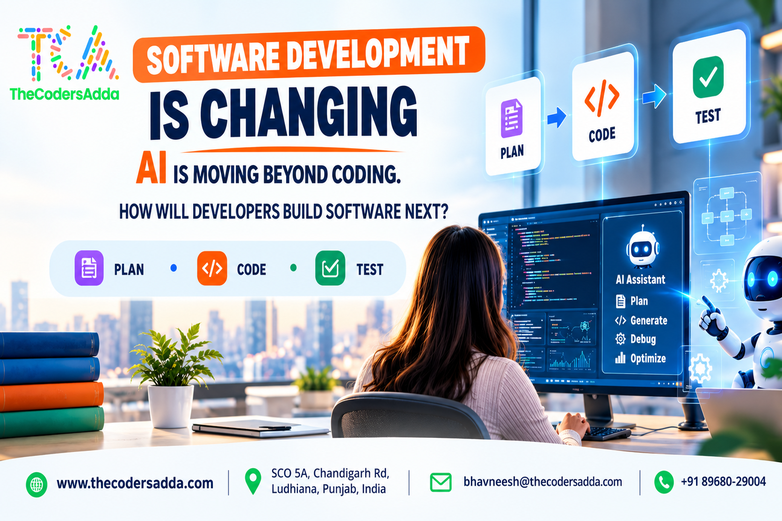
Artificial intelligence is changing software development in ways that go far beyond generating lines of code.
For years, developers have used programming languages, frameworks, libraries, testing tools, version control systems, and deployment platforms to build software. Today, AI is becoming part of many of these activities, helping developers move from an idea to a working application faster and with more automation.
The important shift is not simply that AI can write code.
The bigger change is how developers can use AI across the broader software development lifecycle (SDLC) — from planning and architecture to coding, testing, debugging, code review, documentation, deployment, and maintenance.
As AI-native development becomes more common, developers and businesses need to rethink what efficient software development looks like.
What Is AI-Native Software Development?
AI-native software development refers to a development workflow where AI is integrated into multiple stages of building and maintaining software rather than being used only as a coding assistant.
Traditional development often follows a sequence such as:
Planning → Design → Coding → Testing → Deployment → Maintenance
With AI-assisted workflows, developers can use AI throughout these stages:
Idea → AI-Assisted Planning → Architecture → Code Generation → Testing → Debugging → Review → Deployment → Continuous Improvement
This does not mean that AI replaces developers.
Instead, developers increasingly become responsible for directing AI, validating its output, making technical decisions, and ensuring that the final software meets functional, security, performance, and business requirements.
1. AI Is Changing Software Planning
Software development starts long before the first line of code is written.
Teams need to understand business requirements, define features, identify technical constraints, create user stories, and decide how a system should work.
AI can assist with these early planning activities by helping developers and product teams:
- Break large requirements into smaller tasks
- Generate user stories and acceptance criteria
- Identify potential technical challenges
- Summarize documentation and project requirements
- Suggest possible architectures
- Create initial technical specifications
- Identify missing requirements or edge cases
This can reduce repetitive planning work and help teams explore different approaches before development begins.
However, human judgment remains important. AI-generated plans still need to be checked against business goals, technical limitations, security requirements, and project constraints.
2. AI-Assisted Code Generation Is Becoming Part of Development
Code generation is one of the most visible applications of AI in software engineering.
Developers can describe what they want to build in natural language and use AI tools to generate code, functions, components, database queries, tests, documentation, and other development assets.
For example, instead of manually creating a basic API endpoint, a developer can explain the expected functionality and ask an AI coding assistant to create an initial implementation.
The developer's role then shifts toward:
- Defining the requirements
- Reviewing generated code
- Testing functionality
- Identifying incorrect assumptions
- Improving architecture
- Checking security and performance
- Integrating the code into the larger application
The ability to understand and evaluate code therefore becomes even more important.
3. AI Can Accelerate Testing
Testing is another area where AI can support development teams.
AI can help generate test cases based on requirements or existing code. It can also assist with identifying edge cases, creating unit tests, analyzing test failures, and improving test coverage.
For development teams, this can mean spending less time writing repetitive test structures and more time thinking about whether the software behaves correctly in real-world situations.
AI-assisted testing can support areas such as:
- Unit testing
- Integration testing
- Regression testing
- API testing
- Test case generation
- Bug reproduction
- Edge-case identification
However, automated tests are only useful when they test the right things. Developers still need to determine whether the test strategy actually reflects user requirements and business risks.
4. Debugging Is Becoming More AI-Assisted
Debugging can consume a significant amount of development time.
A single issue may require a developer to examine logs, trace execution, understand dependencies, reproduce the problem, and identify the root cause.
AI tools can assist by analyzing error messages, logs, stack traces, and code context to suggest possible causes and fixes.
Instead of treating debugging as simply:
Find error → Fix error
developers can use AI to explore:
Symptom → Possible causes → Relevant code → Suggested fixes → Validation
The important word is validation.
AI-generated fixes should not automatically be accepted. Developers need to reproduce the problem, evaluate the proposed solution, run tests, and confirm that the fix does not introduce new issues.
5. Code Review Is Moving Beyond Syntax
Code review traditionally focuses on readability, maintainability, bugs, security concerns, architecture, and adherence to coding standards.
AI can help review code before or alongside human reviewers.
It can identify potential:
- Bugs
- Security vulnerabilities
- Performance issues
- Code duplication
- Poor patterns
- Maintainability problems
- Missing tests
This can make code review more efficient, particularly for repetitive checks.
But human review remains valuable for decisions involving architecture, business logic, product requirements, and long-term maintainability.
6. AI Is Influencing Deployment and DevOps
The impact of AI is also reaching deployment workflows.
AI can assist development and DevOps teams with tasks such as analyzing deployment logs, identifying infrastructure issues, generating configuration suggestions, monitoring systems, and investigating incidents.
For example, when an application experiences an unexpected error after deployment, AI can help developers analyze available information and identify potential areas requiring investigation.
This creates opportunities for faster troubleshooting and more automated development pipelines.
At the same time, deployment automation must be carefully controlled. Production systems require strong testing, monitoring, access controls, security practices, and rollback strategies.
7. The Developer's Role Is Changing
If AI can generate code, test software, explain errors, and assist with documentation, what skills should developers focus on?
The answer is not simply learning how to write better prompts.
Developers need a broader combination of technical knowledge, problem-solving ability, system understanding, and AI literacy.
Some of the most important skills include:
Strong Programming Fundamentals
AI can generate code, but developers still need to understand programming concepts.
Knowledge of data structures, algorithms, APIs, databases, design patterns, and software architecture helps developers evaluate whether generated code is actually appropriate.
System Design
As AI makes code generation faster, understanding how different components work together becomes increasingly important.
Developers should understand:
- System architecture
- APIs and microservices
- Databases
- Cloud infrastructure
- Scalability
- Security
- Performance
Critical Thinking
AI-generated output can contain incorrect assumptions or unexpected behavior.
Developers need to ask:
Is this code correct?
But also:
Is this the right solution?
That distinction is important.
Testing and Validation
The ability to validate AI-generated work will become increasingly valuable.
Developers should know how to design meaningful tests, identify edge cases, verify results, and detect failures.
Security Awareness
AI-generated code should never automatically be assumed to be secure.
Developers need to understand common security risks, authentication, authorization, data protection, dependency management, and secure coding practices.
AI Literacy
Developers should understand how AI coding assistants and development agents work, their strengths and limitations, and how to integrate them responsibly into development workflows.
AI Will Not Eliminate the Need for Software Engineers
One of the biggest misconceptions about AI in software development is that developers will no longer be needed because AI can write code.
Software engineering is much more than writing code.
Developers understand requirements, make architectural decisions, evaluate trade-offs, manage complexity, troubleshoot unexpected behavior, and connect technical solutions with business objectives.
AI can accelerate many of these activities, but software still needs people who can define the problem, evaluate solutions, manage risk, and take responsibility for the final result.
The developer of the future may spend less time typing repetitive code and more time thinking about systems, requirements, validation, architecture, and product outcomes.
What Should Developers Learn Next?
Developers preparing for an AI-driven software industry can focus on a combination of traditional engineering skills and emerging AI capabilities.
A practical learning path can include:
- Strengthen programming fundamentals
- Learn system design and architecture
- Understand APIs, databases, and cloud platforms
- Develop strong testing and debugging skills
- Learn secure software development practices
- Experiment with AI coding assistants
- Learn effective AI prompting and context management
- Understand AI-generated code validation
- Explore AI-assisted DevOps and automation
- Build real-world projects using AI throughout the development lifecycle
The goal should not be to become dependent on AI.
The goal should be to become a developer who can use AI effectively while still understanding and controlling the technology being built.
The Future of Software Development Is Human + AI
AI is changing the software development workflow, but the most important transformation is not about replacing developers with machines.
It is about changing how developers work.
Planning can become more intelligent. Coding can become faster. Testing can become more automated. Debugging can become more efficient. Documentation can become easier to maintain. Deployment and monitoring can become increasingly assisted by AI.
But successful software still depends on clear requirements, strong engineering principles, thoughtful architecture, rigorous testing, security, and human decision-making.
For businesses, this means AI can become an important part of building software faster and more efficiently.
For developers, it means the valuable skill is no longer only "Can you write code?"
It is increasingly:
"Can you understand the problem, guide AI toward the right solution, and validate the software it produces?"
That is the direction in which AI-native software development is heading.
Build Smarter Software With The Coders Adda
At The Coders Adda, modern software development combines engineering expertise with emerging technologies to help businesses build scalable digital solutions.
From AI development and web/mobile application development to CRM & ERP solutions, cloud services, IoT, and dedicated development teams, businesses can use technology to solve real operational and customer challenges.
As AI continues to reshape software engineering, organizations that understand how to combine AI capabilities with strong software engineering practices can build more efficient and adaptable technology solutions.
The future of software development is not simply AI writing more code. It is developers using AI to rethink the entire way software is planned, built, tested, and improved.